
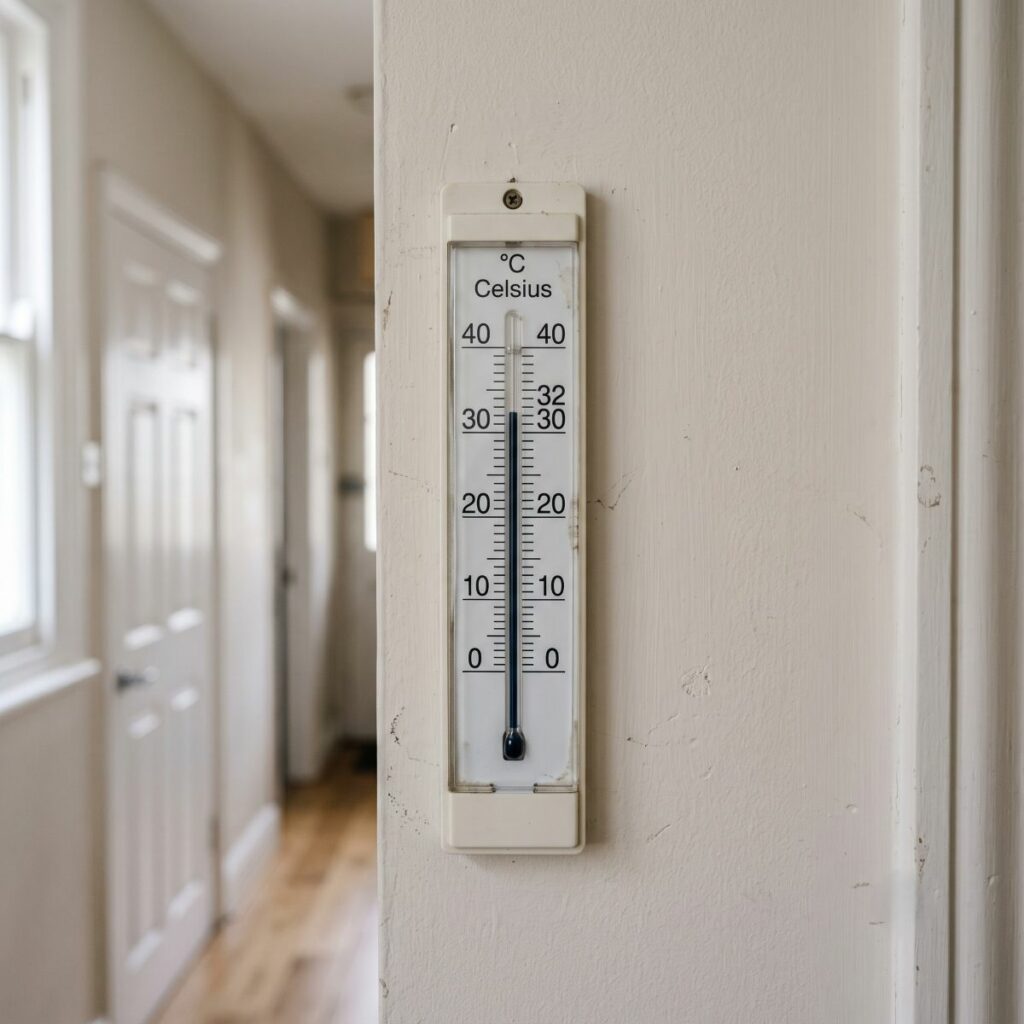
A maisonette on Fortis Green Road, Muswell Hill, second week of August, thirty-one degrees on the pavement and closer to thirty-five in the back bedroom under the roof. The client wanted the whole flat done before her parents arrived on the Saturday. She was delighted when the pile felt dry to the back of the hand by early evening.
She rang me on the Tuesday about three grey rings that had come up on the landing, none of which had been there when I left.
Fast drying sells. Every carpet cleaning website in Greater London has a number on it – one hour, two hours, dry before you get home – and in fairness the number is what most people are buying. Heat gives you that number for free in August. It also gives you a set of failure modes that do not appear in October, and they are the ones I spend the back half of every summer correcting.
What happens when a carpet dries in three hours instead of twelve?
Hot water extraction leaves the pile somewhere around 5 to 10 per cent moisture content, depending on the wand, the vacuum and how patient the operator was on the dry strokes. That water leaves by evaporation, and evaporation happens at the surface. The tips of the pile give up their moisture first, and the deeper structure – the base of the yarn, the primary backing, the underlay if anything got that far – follows behind.
In a normal room the gap between those two stages is small. Push the air temperature to the mid-thirties and the gap widens dramatically. Surface tips can be bone dry while the yarn base is still holding water, and that state is where most of August’s problems are born.
Capillary action does the rest. Water sitting at the base of the pile moves upward towards the drying surface, and it does not travel alone – it carries dissolved soil, detergent residue and anything that soaked into the backing over the previous decade. The water evaporates at the tip. The passengers stay there.
The regain number nobody measures
Wool holds its condition at about 16 per cent moisture regain in standard atmospheric conditions, which is to say it is meant to have water in it. Drive it much below 10 and the fibre goes brittle, loses resilience under foot traffic and picks up abrasion damage faster. A wool-rich carpet parked in a west-facing room at thirty-four degrees for six hours will drop below that.
The damage is quiet. Nobody rings up to complain that their carpet has lost 4 per cent regain. They ring eighteen months later to ask why the traffic lane in the hall has flattened faster than the rest.
Why does the spot come back on Tuesday?
Every returning spot has the same story behind it. Something went into the carpet a long time ago and got no further than the backing – a spilt glass of red, a dog, a leaking radiator valve. Ordinary cleaning takes the top out of it and the client is happy. The residue in the backing sits there.
Then the room gets hot. Moisture in the lower structure heads for the surface, brings that old contamination with it, and deposits it at the tips where you can see it. The rings on the Muswell Hill landing were exactly this – a previous tenant’s something, sitting in the jute for years, brought up by an evaporation rate my dehumidifier could not keep pace with.
The cure is unglamorous. Sub-surface extraction on the affected area, a dwell long enough to dissolve what is down there, and controlled drying afterwards so the same lift does not happen again. Speed is the enemy at every stage of that.
Prespray dwell in a thirty-one degree room
The other half of the residue problem is upstream. A prespray is formulated to sit wet on the fibre for eight to ten minutes while the surfactants do their work. In a hot room it flashes off in three or four.
What is left behind is dried detergent on the fibre, which no longer rinses cleanly, attracts soil at speed, and gives you a carpet that greys again within a month. On a Bunhill Row office job in EC1Y I once watched a subcontractor prespray four hundred square metres in one pass on a Saturday with the building’s cooling shut down for the weekend. The first section was crisp before he had finished spraying the last. Half of that floor had to be redone in September.
Mist the prespray in smaller sections. Work in bays of twenty square metres rather than half a floor. In fairness it slows the job by about a fifth, and the alternative is doing it twice.
What does the heat do to the backing and the seams?
Jute shrinks as it dries. A secondary jute backing that has been wetted and then dried hard and fast contracts unevenly against a primary backing that behaves differently, and what you get is rippling, edge curl on rugs, and seam peaking where two lengths meet.
Latex adhesive between the two backings softens well before you reach the temperatures a top-floor London flat hits in a heatwave. Soft latex plus differential shrinkage is how delamination starts – it rarely shows on the day, then a year later the carpet moves under foot near the doorway and everyone blames the fitter.
Wool-rich Axminster on a stair run is the version that costs money. In fairness the shrinkage is small in absolute terms, a few millimetres across a two-metre width, and on a stair that is enough to lift a nosing and expose the gripper. Twice now, both in August, both after somebody dried hard with three air movers pointed up the flight.
Carpet tiles and the weekend shutdown
Bitumen-backed tiles are the worst version of this. Offices switch their cooling off on Friday evening, the cleaning contractor comes in Saturday, and the tiles spend two days in a sealed thirty-degree floorplate. Bitumen goes plastic, tiles curl at the corners, and Monday morning arrives with a tripping hazard and a facilities manager who wants to know what you did.
I ask for the cooling to stay on. If the answer is no, I move the job.
Should you open the windows?
No, and this is where I lose friends in the trade.
The instinct is universal. Hot day, wet carpet, throw the sashes up and get some air through. The logic holds in April. It falls apart in a genuine heatwave, and the reason is that ventilation moves air rather than removing water.
Drying depends on the moisture gradient between the carpet and the air immediately above it. What matters is how much water that air is already carrying, and hot air outside a London flat in August is carrying a great deal of it. A thirty-degree day at 55 per cent relative humidity holds roughly fifteen grams of water per kilogram of air. A closed room at twenty-two degrees running a dehumidifier can be held at eight or nine. Open the window and you have replaced dry air with wet, warm air, then congratulated yourself on the breeze.
The breeze does still dry the tips, which is the trap. Surface evaporation accelerates, the substrate lags further behind, and you have manufactured the exact conditions for contamination to travel upward. Faster surface drying with a wetter room is the worst combination available.
What I run instead: room sealed, one dehumidifier, and fewer air movers than most operators would use – two in a lounge rather than four, aimed low and across the pile rather than straight down at it. The target is an even, moderate drying rate through the full depth of the carpet. A wool carpet that takes nine hours to dry through beats one that felt dry in ninety minutes and greyed by Tuesday.
I carry a cheap hygrometer and I put it on the floor rather than the mantelpiece, because the air the carpet is drying into is the air in the bottom foot of the room. If it reads above 60 per cent an hour in, the dehumidifier is undersized and I would rather know at nine in the morning than at four. Most domestic jobs in a two-bedroom flat need one twenty-litre unit. A through-lounge in a converted Victorian house on Court Road, Eltham, needed two, and I only found that out by measuring.
That position gets argued with. The one-hour dry claim is a sales metric and it has been treated as a quality metric for twenty years, and I think it has caused more callbacks across this industry than slow drying ever has.
Rugs and direct sunlight
Never dry a rug in the sun. Not on a balcony in Eltham, not over a fence in Osterley, not on a roof terrace anywhere. Direct sun through a south-facing sash will do it too.
Two things happen. Dyes fade unevenly, so the exposed half shifts and the shaded half does not, and on a hand-knotted rug the migration of loose dye during rapid drying can put pink into a cream field permanently. Flat, shaded, air moving underneath on a raised rack. That is the whole method.
How should an August clean be booked?
Start early. I take the first slot at half seven and try to have the wand out of a flat by eleven, which puts the controlled drying phase in the coolest usable part of the day.
Second best is late afternoon into evening, letting the carpet dry overnight when outdoor absolute humidity drops. The worst booking in the calendar is one o’clock on a top-floor flat with south-facing glass, and I will say so on the phone rather than take it.
What changes in the method
Slower passes, more dry strokes, sectioned prespray, cooler solution on wool. A moisture meter pushed into the base of the pile before I leave, rather than a hand laid on the tips. Written note to the client about keeping windows shut and the dehumidifier running, which about half of them ignore.
The Muswell Hill landing took two hours to put right and I did not charge for it, because the rings were mine – the drying was, anyway. She kept the windows shut the second time and the carpet is still clean.